


I’ve been thinking lately about what it means to call something luxurious. For most of recent history, the answer was simple: rarity, exclusivity, expense. A thing was luxurious because most people couldn’t have it. The story ended there. The diamond’s journey from a mine in Botswana to a boutique on Bond Street was not part of the product — it was invisible by design. That invisibility is no longer available. And its absence is changing everything.
A Shift in Consumer Mindset
The most significant force reshaping the jewelry industry right now is not a technology or a material. It is a question: where did this come from? That question is being asked by a generation of consumers who grew up with instant access to information that previous generations simply didn’t have. They can read about labor conditions in artisanal mining operations in the Congo. They can compare the carbon footprints of different production methods. They can follow researchers and activists whose entire careers are devoted to making supply chains legible to the people at the end of them.
This is not a niche sensibility. According to multiple surveys tracking luxury purchasing behavior, sustainability is now a deciding factor for the majority of buyers under 40. And these aren’t marginal participants in the fine jewelry market — they are its fastest-growing segment.
The effect on industry is measurable. Designers, brands, and retailers are investing in supply chain documentation in ways they never did before. Certification programs have proliferated. Blockchain-based traceability platforms have moved from proof-of-concept to commercial deployment. The broader pattern of sustainable jewelry trends — favoring verified origins, recycled metals, and low-impact production — has shifted from the periphery of the market to one of its primary growth vectors.
What is striking about this shift is how quickly it has moved from aspiration to expectation. Brands that once treated sustainability as a differentiator are discovering it is becoming a minimum threshold. The consumer who cared about origins in 2018 was ahead of her time. The one who cares in 2025 is simply typical.
See also: Home Staging Services to Maximize Your Home’s Market Appeal
Beyond Aesthetics: The Ethics of Design
Design has always been about choices. Material versus material. Form versus function. What to emphasize and what to leave out. But for much of jewelry’s modern history, those choices have been made primarily on aesthetic and commercial grounds. What looks beautiful? What can be sourced at scale? What will sell?
The emerging generation of jewelry designers is adding a third column to that calculation: what is the cost of this choice, and to whom? This manifests in practical ways. The sourcing of gold — one of the most environmentally damaging extraction processes on earth — is being scrutinized with new seriousness. Fairmined and Fairtrade gold certifications, once niche, are increasingly expected by buyers who have done the research. Recycled precious metals have moved from a sustainability footnote to a genuine design consideration, with some designers building their entire aesthetic around the story of material provenance.
The shift in how designers think about gemstones is equally profound. For a stone to work in a contemporary fine jewelry context — particularly for the buyers who are driving growth in the category — its origin needs to be part of its story. A provenance gap is no longer neutral. It is a negative.
The Rise of Responsible Innovation
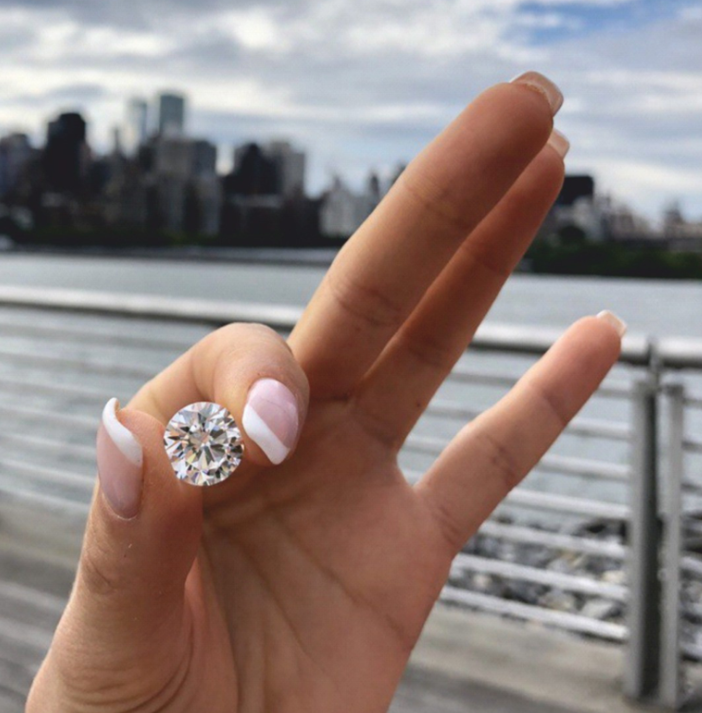
The most dramatic material development in this space is also the most discussed: the emergence of laboratory-grown diamonds as a mainstream alternative to mined stones. The technology has been available for decades, but its commercial viability has transformed over the past ten years. Using CVD and HPHT processes, producers can now grow diamonds that are chemically and structurally indistinguishable from mined equivalents — certified by the same grading bodies, held to the same quality standards, carrying the same physical and optical properties.
What they do not carry is the supply chain complexity, the environmental footprint of open-pit extraction, or the geopolitical entanglement that has shadowed the mined diamond market for generations. For designers thinking seriously about responsible diamond design — the idea that a stone’s creation should be as considered as its setting — this is not a compromise. It is a solution.
The creative implications are also underappreciated. Laboratory production allows for specifications — size, color, quality — that would be rare or impossible to source consistently in mined form. Designers who once worked within the constraints of what the earth happened to produce in recoverable quantities are now working with a level of precision that changes what is designable. This is not just about ethics. It is about possibility.
Industry at a Crossroads
The established houses of fine jewelry are navigating this shift with varying degrees of grace. Some have moved deliberately: launching lab-grown lines, publishing supply chain disclosures, committing to measurable environmental targets. They are doing this not out of altruism — though that may play a role — but because their customers are asking for it, their investors are measuring it, and their boards understand that a brand built on values needs to be able to demonstrate those values under scrutiny.
Others are holding the line on tradition. Natural rarity, geological time, the irreplaceable quality of something formed beneath the earth over billions of years — these are real arguments, and they resonate with a real segment of buyers. There is no reason to assume that mined diamonds will disappear from the market. Scarcity has commercial value. Heritage has emotional resonance.
But the growth is not coming from that segment. The growth is coming from buyers who want exceptional quality, compelling design, and a supply chain they can explain to themselves without discomfort. And those buyers are increasingly well-served by brands that weren’t in the market fifteen years ago.
The pressure on incumbents is genuine. Adaptation is happening, but unevenly. The brands that are farthest ahead are those that decided early that sustainability was a design principle rather than a compliance exercise — something to build around rather than accommodate.
The Future of Meaningful Luxury
If I had to describe what the fine jewelry market looks like in ten years, I would say this: the segment that treats sustainability as optional will be smaller. The segment that treats it as foundational will be larger. And the distance between those two positions — which currently still feels like a spectrum — will have collapsed into something more binary.
This is not because consumers are becoming more idealistic. It is because the alternatives are becoming better. A buyer in 2035 will be able to access a certified, high-quality diamond with complete supply chain documentation at a price point that was simply not available to her in 2015. The argument for choosing opacity will have weakened further. The argument for choosing accountability will have strengthened.
Luxury has always been about the story a purchase tells — about the buyer, about their values, about what they believe matters. For most of the twentieth century, that story was about acquisition and exclusivity. In the years ahead, it will increasingly be about integrity. That is not a diminishment of luxury. It is its evolution. And the designers and brands building for that future are not compromising on beauty or excellence. They are redefining what excellence includes.