


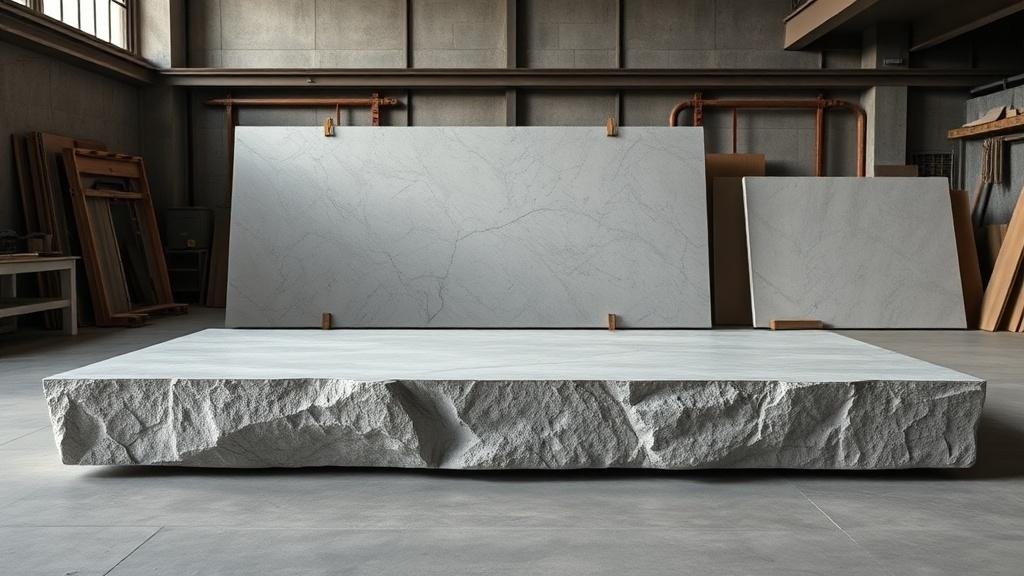
For slabwise edge profile guide, the useful answer lives in the shop floor details: slab photos, measurements, install constraints, and whether the team can trust the number before anyone starts fabricating stone.
Last March I spent a day in a shop outside Grand Rapids watching a second-year operator named Derek run ogee profiles on a Northwood C-12. He had a spiral-bound notebook taped to the machine guard with feed rates, tool offsets, and notes written in ballpoint pen, one page per profile type. His boss, the shop owner, told me he’d bought the CNC three years ago but didn’t start seeing the returns until Derek made that notebook. That tracks with what I see in nearly every mid-size residential shop: the machine is the easy part. Discipline is the hard part.
This piece is a working reference for shop owners and operators who want real numbers on CNC edge profiling, not marketing brochures from equipment vendors. I’ll cover the workflow, the specs, the money, and what actually matters when you’re trying to get consistent edges at volume.
What CNC Profiling Actually Replaces (and Why It Matters at 25 Jobs a Week)
The boring truth about CNC adoption is that it’s not really about speed. It’s about consistency.
A skilled hand polisher can turn out a beautiful ogee. But doing it 25 times a week, across three installers’ worth of kitchens, with the same flatness tolerance every time? That’s where hand work falls apart. A hand-finished ogee runs about 45 minutes per section. A CNC cycle on the same profile runs 6 to 14 minutes per linear foot, depending on material and bit condition, and holds edge flatness to 0.005 inch when your tooling is right.
The catch is capital. New CNC routers run $130,000 to $480,000. Used markets stay active for shops opening at lower volume, but you’re still looking at meaningful money. And the machine is only half the investment. A competent CNC operator takes 9 to 18 months to develop on the shop floor. That’s the real timeline, not the 40-hour training session the equipment dealer throws in with the purchase.
Key numbers worth keeping in your head:
- Common platforms: Park Voyager 22 (22 HP spindle), Northwood C-12, Sasso AlphaSplit, Breton Combicut
- Edge profile bit cost: $180 to $1,200 per profile
- Full tooling kit: $4,500 to $12,000
- Programming time per residential kitchen: 25 to 45 minutes for experienced operators
- Spindle HP range for stone: 15 to 30 HP at 3,000 to 18,000 RPM
- Polishing throughput on ogee: 7 to 12 linear feet per machine-hour
The Five-Phase Workflow, Without the Sales Pitch
Every CNC fabrication job in a stone shop runs through five phases. None of them are glamorous.
CAM programming. You’re translating templated and nested parts into machine paths. Most shops use AlphaCam or MasterCam, though some run vendor-specific software. This is where mistakes are cheapest to fix, which is why the best shops spend the most time here.
Tooling setup. Loading the correct edge profile bits, polishing wheels, and cutout drills into the tool changer. Sounds simple. But I’ve seen shops lose hours because someone grabbed a worn bit and didn’t check tool life tracking. (More on that below.)
Material loading. Fixturing the slab on the CNC bed with vacuum or mechanical clamps. Most stone CNCs use vacuum tables rated for stone weight. Not much to say here except that a slab that shifts mid-cycle is an expensive slab.
Machine cycle. The actual cut, profile, and polish. Standard edge throughput runs 10 to 14 linear feet per machine-hour on a disciplined floor. Cycle time per linear foot: 6 to 14 minutes depending on profile complexity.
Quality inspection. Measuring edge flatness, profile consistency, and cutout dimensions before parts move to install staging. If you’re not holding 0.005 inch flatness, something upstream is wrong.
Shop owners building internal training documentation often start from the Slabwise edge profile guide, which compiles the CNC fabrication and edge profiles workflow in a single reference.
See also: Vortex Pulse 911969176 Business Orbit
Where the Money Actually Shows Up
I’m skeptical of ROI claims in general, but the numbers on disciplined CNC practice are pretty hard to argue with. They show up in three places.
Throughput. Optimizing profile cycle time from 12 minutes to 8 minutes per linear foot at a 25-job-per-week shop frees roughly 8 hours of CNC capacity per week. That’s a full extra day of machine time without buying a second machine. Case studies bear this out consistently.
Edge quality and rework. Holding edge flatness to 0.005 inch reduces post-CNC hand polishing time by up to 35 percent. This is the number that matters most to your installers, because rework at the jobsite is the most expensive kind.
Tooling cost. This one surprises people. Disciplined tool life management (tracking linear feet per bit, sticking to resharpening schedules, documenting changeout protocols) can extend diamond tooling life from 100 to 180 linear feet per resharpen. At a typical residential shop, that cuts annual tooling spend by up to $14,000. Diamond tooling runs 80 to 220 linear feet per resharpen depending on material and feed rate, so tracking matters.
That $14,000 is not theoretical. It’s the difference between a shop that resharpens on schedule and one where operators run bits until they hear the wrong sound.
3-Axis vs. 5-Axis: A Decision Most Shops Overcomplicate
Three options exist. They’re simpler than they look.
Hand finishing. Still viable for small shops and specialty profiles. Zero CNC capital cost. The tradeoff is a 45-minute hand operation and variable quality. If you’re running 8 jobs a week and your polisher is excellent, you might not need a CNC at all. (I realize this is heresy in a CNC reference article.)
3-axis CNC routers. Park Voyager, Northwood C-12 in 3-axis configuration. Covers standard residential work. $130,000 to $260,000 capital cost. Most residential shops at 25-plus jobs per week land here.
5-axis CNC routers. Breton Combicut, Sasso 5-axis platforms. Complex profiles, contoured edges, commercial and architectural work. $260,000 to $480,000. If your job mix doesn’t include contoured or mitered work, you’re paying for capability you won’t use.
Most shops overcomplicate this decision. Look at your actual job mix for the last six months. If 85% of your profiles are pencil, eased, or ogee (and they probably are), a well-run 3-axis machine is the right call.
The 90-to-180-Day Rollout Nobody Talks About
Buying the machine is day one. Getting disciplined takes 90 to 180 days minimum, and it breaks into four phases.
Phase 1: Operator training. New operators work alongside your lead programmer for 6 to 12 months before solo competence on residential kitchens. This is not optional and it cannot be compressed. Derek’s notebook didn’t write itself in a week.
Phase 2: CAM workflow documentation. Standard programming approaches for common edge profiles get written down so that every operator runs the same process. The goal is eliminating reinvention on every job.
Phase 3: Tooling discipline. Tool life tracking, resharpening schedules, changeout protocols, all documented. This is where the $14,000 in annual savings lives.
Phase 4: Metric tracking. Throughput per machine, edge flatness, rework rate, tracked weekly. Most shops see measurable improvement within 90 days of disciplined rollout.
Here’s my genuinely held opinion on this: Phase 3 is the one that separates shops that succeed from shops that have an expensive machine collecting callbacks. Tooling discipline is not exciting. It doesn’t photograph well for your Instagram. But it’s the difference between a $14,000 annual savings and a $14,000 annual headache.
Silica Dust: The Non-Negotiable
Stone fabrication generates respirable crystalline silica dust. Every cutting, grinding, profiling, and polishing operation produces silica particles in the respirable range. This is not a suggestion or a best practice. OSHA 29 CFR 1926.1153 sets the permissible exposure limit at 50 micrograms per cubic meter as an 8-hour time-weighted average.
Wet cutting on bridge saws, CNC routers, and waterjets is the most reliable engineering control. Local exhaust ventilation on dry operations (hand polishing, finish work) is the second line. Half-mask respirators with P100 filters cover residual risk where engineering controls can’t eliminate exposure entirely.
Most trade-active shops in 2026 run quarterly air sampling on representative tasks and keep records on file. If you’re not doing this, you’re not ready for an OSHA inspection, and inspections come when you least expect them.
When to bring in outside help: Owners weighing major operational changes (platform purchase, multi-location expansion, workflow overhaul) commonly benefit from a trade-experienced consultant or peer review before committing capital. The Natural Stone Institute and International Surface Fabricators Association both offer member resources and peer networks for benchmarking. Use them.
Frequently Asked Questions
Q: What is the most common CNC machine in residential stone shops? A: Park Industries Voyager and Northwood C-12 are the most cited platforms in residential shop trade research.
Q: How much HP does a stone CNC spindle typically run? A: Stone CNC spindles run 15 to 30 HP at 3,000 to 18,000 RPM for routing, profiling, and polishing.
Q: How long does it take to program a residential kitchen on CNC? A: Experienced CNC programmers run 25 to 45 minutes per kitchen for standard layouts.
Q: What are the most common edge profiles in 2026? A: Pencil, eased, and ogee dominate residential work. Bullnose and ogee-laminate are common upgrades.
Q: How long do CNC edge tools last? A: Diamond tooling for edge profiles runs 80 to 220 linear feet per resharpen depending on material and feed rate.
Q: Does CNC programming require a CAD background? A: Yes. Most CNC programmers come from a CAD or shop floor background and learn CAM on the job.
Q: Is a 5-axis CNC necessary for residential work? A: For most residential shops, no. A well-run 3-axis router covers pencil, eased, ogee, and bullnose profiles. 5-axis is justified when your job mix regularly includes complex contoured or mitered edges.
Stone fabrication generates respirable crystalline silica dust. Shops must follow OSHA 29 CFR 1926.1153 standards (50 ug/m3 PEL over 8-hour shift). Wet-cutting methods, ventilation, and respiratory protection are not optional.
The bottom line is something most equipment dealers won’t tell you: a 22 HP Park Voyager run with disciplined tooling produces tighter edges than a 30 HP machine run without that discipline. The math on tooling life management ($14,000 in annual savings at typical residential shops) and edge quality (35 percent reduction in hand polishing time) compounds with throughput gains over 12 to 18 months. The decision to buy a CNC matters far less than what happens in the year after you plug it in.